

 中文简体
中文简体 Español
 عربى
عربى
Request for a call today
Why Choose an Aluminum Safety Padlock for Security?
An aluminum safety padlock is not just a lightweight version of a steel lock. It serves specific roles where weight, corrosion resistance, and non-sparking properties matter more than raw cutting strength. Understanding where an aluminum safety padlock fits helps buyers make better decisions for industrial safety programs, outdoor storage, or facility management.
Material choice affects performance
The body of an aluminum safety padlock is made from aluminum alloy, not steel. This changes how the lock behaves in real conditions.
Aluminum does not rust. Steel locks corrode over time in wet or coastal environments. An aluminum safety padlock stays functional outdoors, near pools, or in high-humidity facilities.
Aluminum is lightweight. A worker carrying multiple locks for lockout/tagout procedures avoids fatigue. An aluminum safety padlock weighs much less than a brass or steel equivalent.
Aluminum does not spark. In chemical plants, grain elevators, or areas with flammable dust, an aluminum safety padlock reduces ignition risks.
The shackle material varies. Some aluminum safety padlock models use steel shackles for cutting resistance. Others use aluminum shackles for full non-sparking compliance. Buyers should verify this based on their hazard environment.
Where an aluminum safety padlock excels
Industrial safety programs often specify an aluminum safety padlock for lockout/tagout (LOTO) applications. OSHA and other safety standards require that each worker has their own lock with a unique key. An aluminum safety padlock meets this requirement while being comfortable to carry all shift.
Outdoor electrical cabinets, water treatment plants, and marine facilities benefit from an aluminum safety padlock because it withstands moisture without seizing. Unlike steel locks that develop rust inside the cylinder, an aluminum safety padlock keeps the mechanism clean and operational.
Schools, gyms, and office lockers also use an aluminum safety padlock because the light weight prevents damage to locker doors. Heavy steel locks can bend thin locker metal over time.
Color coding and identification
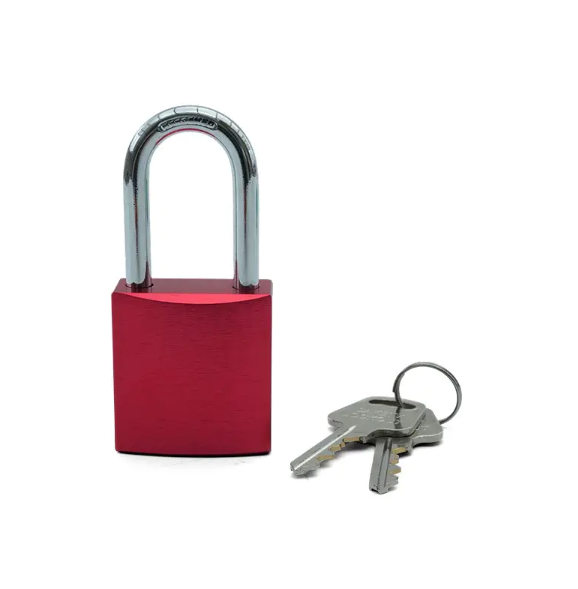
One practical advantage of an aluminum safety padlock is the ability to anodize the body in different colors. Red, blue, yellow, green, black, orange, purple, and white are common options.
Color coding helps in several ways:
- Different departments use different colored an aluminum safety padlock for quick visual sorting.
- Individual workers claim a specific color to recognize their own an aluminum safety padlock among dozens on a lockout board.
- Safety levels or shift assignments can be indicated by an aluminum safety padlock color without reading small labels.
Some manufacturers offer engraving or printing on the an aluminum safety padlock body for company logos, employee IDs, or serial numbers. This turns a simple lock into a traceable asset.
Cylinder and key security
The security of an aluminum safety padlock comes from its cylinder, not the body material. Most quality models use a brass cylinder with copper pins. Brass resists drilling and provides smooth key operation.
An aluminum safety padlock can be keyed in several ways:
- Keyed alike – Multiple locks open with the same key. Useful for a supervisor or maintenance team.
- Keyed different – Each lock has a unique key. Standard for individual worker LOTO locks.
- Master keyed – A master key opens all locks while each lock has its own change key. Common for facility management.
For high-security applications, an aluminum safety padlock can be ordered with restricted keyways. This prevents unauthorized key duplication.
Size and shackle options
An aluminum safety padlock comes in different body widths, typically 30mm, 40mm, or 50mm. Smaller sizes fit locker hasps and toolboxes. Larger sizes accommodate thick industrial shackles.
Shackle options include:
- Standard length for general use
- Long shackle for thick hasps or multiple locked points
- Coated shackle to prevent scratching painted surfaces
- Stainless steel shackle for added corrosion resistance
The shackle diameter on an aluminum safety padlock varies from 5mm to 8mm. Thicker shackles resist bolt cutter attacks better but add weight.
Limitations to understand
An aluminum safety padlock is not the right choice for every situation. It does not resist cutting or prying as well as a hardened steel lock. For high-theft areas or outdoor storage sheds with valuable contents, a steel lock is more appropriate.
The lighter weight of an aluminum safety padlock also means less inertial force when dropped. Some users feel it seems less substantial, but that perception does not reflect proper security for its intended applications.
Maintenance and lifespan
An aluminum safety padlock requires minimal maintenance. The aluminum body does not need oil or rust protection. The brass cylinder benefits from occasional graphite lubrication if the key starts turning roughly.
If an aluminum safety padlock gets dirty, washing with fresh water and drying thoroughly keeps it functional. Saltwater exposure should be rinsed off to prevent long-term surface pitting, though the lock will still operate.
Most manufacturers rate an aluminum safety padlock for outdoor use with expected service life of several years. After that, the cylinder may wear or the shackle spring may weaken. Replacement is inexpensive compared to the cost of a security incident or safety violation.
Making the right choice
Selecting an aluminum safety padlock comes down to matching the lock to the threat and environment. For indoor lockers, toolboxes, and LOTO boards, an aluminum safety padlock offers ideal weight and corrosion resistance. For outdoor electrical cabinets, marine hatches, and chemical plant valves, an aluminum safety padlock provides non-sparking safety and weather durability.
For high-security fencing, storage units, or any application where cutting resistance is the top priority, a steel lock remains the better answer. Understanding these tradeoffs ensures that an aluminum safety padlock gets used where it performs best, not where it will fail prematurely.

 Tel: +86-18858990200
 E-mail: [email protected]
 Add: No. 77, Yidianhong Avenue, Pujiang County, Jinhua City, Zhejiang Province
Copyright 2025 Pujiang Qiying Industry and Trade Co., Ltd. All Rights Reserved 
Custom Lock Cylinder Manufacturers