

 中文简体
中文简体 Español
 عربى
عربى
Request for a call today
Door Key Cylinder vs Thumbturn Cylinder Lock: Which One Should You Choose?
When the time arrives to refresh the entrance hardware on a Victorian terrace, a new-build flat, or a commercial stockroom, owners confront the same quiet question: should the door be fitted with a Door Key Cylinder or a Thumbturn Cylinder Lock? The answer shapes daily convenience, emergency egress, and overall security. By examining both formats side-by-side and by considering the growing market for Bespoke Locks, householders can select hardware that satisfies insurers, residents, and fire-safety officers alike.
A Door Key Cylinder requires a key to lock or unlock the door from either side. In practice, this means that when the last resident leaves, the key must be used to throw the bolt; conversely, anyone already inside needs the same key to exit. A Thumbturn Cylinder Lock replaces the inside key with a small thumb-turn knob. One quick twist and the latch retracts, allowing instant departure without hunting for a key. Both devices fit the same euro-profile cut-out, so swapping between a Door Key Cylinder and a Thumbturn Cylinder Lock is usually a five-minute job with a single screw.
Security professionals often praise the Door Key Cylinder for its balanced key control. Because both sides are keyed alike, there is no risk of an opportunist reaching through a letterbox to flick a thumb-turn. Modern three-star Door Key Cylinder models also include anti-snap, anti-bump, and anti-drill features that satisfy the latest British Standard. Landlords like the fact that a lost key can be replaced without removing the entire lock and that patented keyways prevent casual duplication at high-street kiosks.
Yet convenience can tip the scale toward the Thumbturn Cylinder Lock, especially in flats above the ground floor. Picture a nighttime emergency: lights are off, smoke alarms are sounding, and occupants need to leave immediately. The Thumbturn Cylinder Lock allows the door to be opened in one fluid motion, even by children who may not know where the key is kept. For this reason, many fire services recommend a Thumbturn Cylinder Lock on final exit doors, provided the outer face is reinforced against snapping.
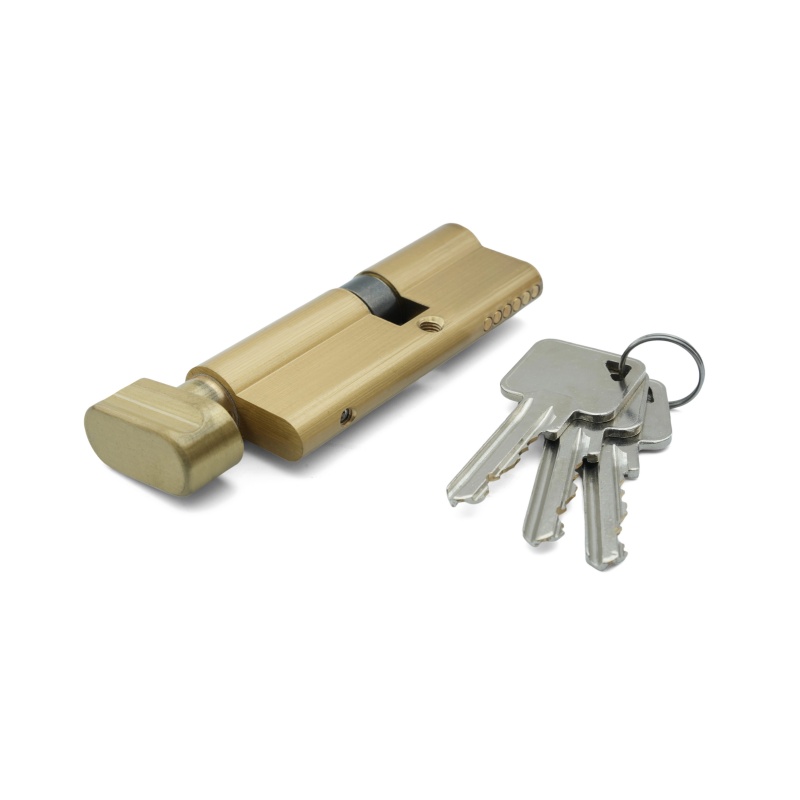
Where does personality enter the equation? Through Bespoke Locks. A growing network of specialist workshops now crafts Bespoke Locks that combine the best of both formats. Customers can order a Bespoke Locks configuration that presents a key outside while offering a thumb turn inside, but with an added escutcheon that shields the turn from casual tampering. Others commission Bespoke Locks in specialist finishes—satin copper, marine-grade stainless steel, or even colour-matched powder coating—so that the cylinder becomes a design feature rather than a utilitarian afterthought. Because Bespoke Locks are machined in small batches, buyers can specify uncommon lengths for oversized communal doors or heritage letterplates.
Cost considerations are surprisingly modest. A standard Door Key Cylinder starts at around twenty pounds, while a Thumbturn Cylinder Lock carries a small premium for the internal knob. Moving up to Bespoke Locks naturally raises the price, yet the uplift is often less than replacing a scratched door handle set. Insurance underwriters increasingly recognise certified cylinders, whether Door Key Cylinder or Thumbturn Cylinder Lock, so the investment can repay itself through lower premiums.
Maintenance is equally straightforward. Both formats benefit from an annual spray of graphite lubricant and a quick wipe of the key to remove grit. Owners of Bespoke Locks receive a tiny bottle of matching touch-up paint, ensuring that the decorative finish remains pristine even after years of daily use.
Ultimately, the choice between a Door Key Cylinder and a Thumbturn Cylinder Lock hinges on lifestyle, occupancy pattern, and local risk profile. Households with young children or elderly residents may value the rapid exit offered by a Thumbturn Cylinder Lock. Properties that require strict key control—shared student houses, short-let apartments or storage rooms—often favour the Door Key Cylinder. And for anyone who refuses to compromise aesthetics, Bespoke Locks delivers tailored solutions that harmonise security, safety, and style under one neatly machined barrel.

 Tel: +86-18858990200
 E-mail: [email protected]
 Add: No. 77, Yidianhong Avenue, Pujiang County, Jinhua City, Zhejiang Province
Copyright 2025 Pujiang Qiying Industry and Trade Co., Ltd. All Rights Reserved 
Custom Lock Cylinder Manufacturers